Today
20
in History
26
January
February
March
April
May
June
July
August
September
October
November
December
01
Sun
02
Mon
03
Tue
04
Wed
05
Thu
06
Fri
07
Sat
08
Sun
09
Mon
10
Tue
11
Wed
12
Thu
13
Fri
14
Sat
15
Sun
16
Mon
17
Tue
18
Wed
19
Thu
20
Fri
21
Sat
22
Sun
23
Mon
24
Tue
25
Wed
26
Thu
27
Fri
28
Sat
29
Sun
30
Mon
31
Tue
...
03-11-1942
General MacArthur leaves Corregidor
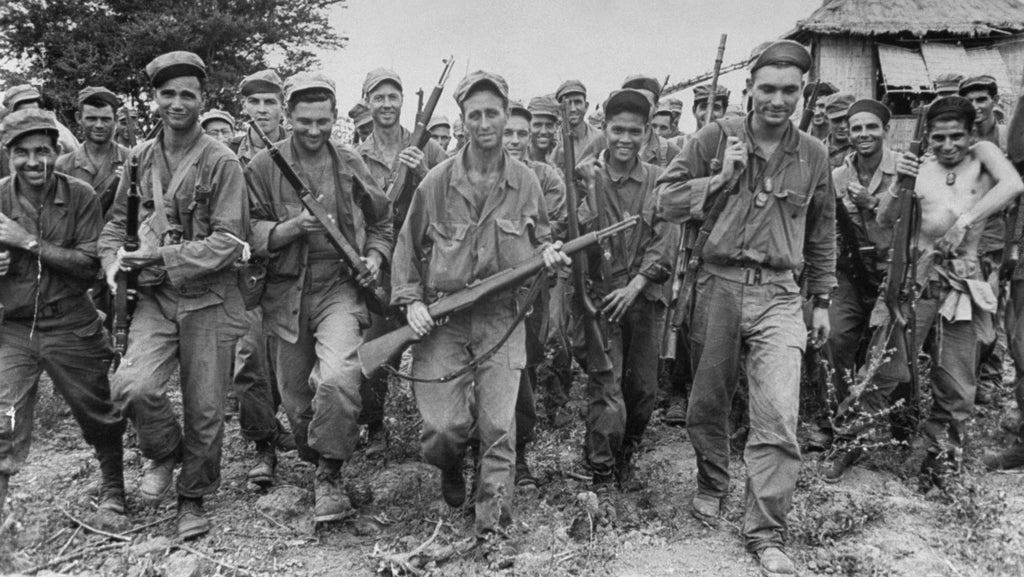
After struggling against great odds to save the Philippines from Japanese conquest, U.S. General Douglas MacArthur abandons the island fortress of Corregidor under orders from President Franklin Roosevelt. Left behind at Corregidor and on the Bataan Peninsula were 90,000 American and Filipino troops, who, lacking food, supplies and support, would soon succumb to the Japanese offensive.
After leaving Corregidor, MacArthur and his family traveled by boat 560 miles to the Philippine island of Mindanao, braving mines, rough seas and the Japanese Navy. At the end of the hair-raising 35-hour journey, MacArthur told the boat commander, John D. Bulkeley, “You’ve taken me out of the jaws of death, and I won’t forget it.” On March 17, the general and his family boarded a B-17 Flying Fortress for Northern Australia. He then took another aircraft and a long train ride down to Melbourne. During this journey, he was informed that there were far fewer Allied troops in Australia than he had hoped. Relief of his forces trapped in the Philippines would not be forthcoming. Deeply disappointed, he issued a statement to the press in which he promised his men and the people of the Philippines, “I shall return.” The promise would become his mantra during the next two and a half years, and he would repeat it often in public appearances.
For his valiant defense of the Philippines, MacArthur was awarded the Congressional Medal of Honor and celebrated as “America’s First Soldier.” Put in command of Allied forces in the Southwestern Pacific, his first duty was conducting the defense of Australia. Meanwhile, in the Philippines, Bataan fell in April, and the 70,000 American and Filipino soldiers captured there were forced to undertake a death march in which at least 7,000 perished. Then, in May, Corregidor surrendered, and 15,000 more Americans and Filipinos were captured. The Philippines–MacArthur’s adopted home–were lost, and the U.S. Joint Chiefs of Staff had no immediate plans for their liberation.
After the U.S. victory at the Battle of Midway in June 1942, most Allied resources in the Pacific went to U.S. Admiral Chester Nimitz, who as commander of the Pacific Fleet planned a more direct route to Japan than via the Philippines. Unperturbed, MacArthur launched a major offensive in New Guinea, winning a string of victories with his limited forces. By September 1944, he was poised to launch an invasion of the Philippines, but he needed the support of Nimitz’s Pacific Fleet. After a period of indecision about whether to invade the Philippines or Formosa, the Joint Chiefs put their support behind MacArthur’s plan, which logistically could be carried out sooner than a Formosa invasion.
On October 20, 1944, a few hours after his troops landed, MacArthur waded ashore onto the Philippine island of Leyte. That day, he made a radio broadcast in which he declared, “People of the Philippines, I have returned!” In January 1945, his forces invaded the main Philippine island of Luzon. In February, Japanese forces at Bataan were cut off, and Corregidor was captured. Manila, the Philippine capital, fell in March, and in June MacArthur announced his offensive operations on Luzon to be at an end; although scattered Japanese resistance continued until the end of the war in August. Only one-third of the men MacArthur left behind on March 11, 1942, survived to see his return. “I’m a little late,” he told them, “but we finally came.”
More news today
loading...